Six hundred years of history has a weight to it.
You feel it when you walk through Gwanghwamun Gate — the main southern entrance of Gyeongbokgung Palace — and the noise of Seoul's streets suddenly drops away. Ahead of you stretches the palace courtyard: stone-paved, vast, framed by mountains in the distance. To your left and right, the great halls of the Joseon Dynasty stand exactly where they've always stood.
And then, in April, you look up. Cherry blossom trees line the paths between the buildings, their pink and white petals drifting down onto 600-year-old stone.
It's one of the most distinctly Korean images you'll encounter anywhere in the country.
Gyeongbokgung Palace: The Basics
Gyeongbokgung — "Palace Greatly Blessed by Heaven" — was built in 1395 as the primary royal palace of the Joseon Dynasty. It's the largest of Seoul's five grand palaces, housing over 500 structures at its peak. Destroyed during the Japanese invasion of 1592, left vacant for 270 years, partially restored in the 19th century, and then systematically dismantled again during Japanese colonial rule (1910–1945), the palace has been undergoing ongoing restoration since Korean independence.
What stands today is both ancient and still being rebuilt — a work-in-progress that makes the palace more interesting, not less.
📍 Official info: Gyeongbokgung Palace Official Site →
📍 Visit Seoul guide: Visit Seoul — Gyeongbokgung →
🌸 Gyeongbokgung in Spring: What to Expect
Spring transforms Gyeongbokgung in a way that no other season does. Cherry blossoms soften the palace's severe grandeur — the stone courtyards, the towering gates, the formal symmetry of the architecture — with something delicate and temporary.
The most photogenic spring moments happen at:
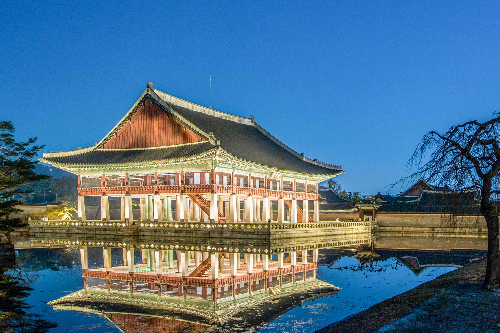
- Gyeonghoeru Pavilion — the grand two-story pavilion "floating" on a man-made pond. Cherry blossom branches frame the reflection in the water. This is the postcard shot of Gyeongbokgung.
- Amisan Garden — the queen's back garden, quieter and less visited than the main courtyards, with traditional chimney structures framed by blossoms
- The path between Geunjeongjeon and Gyeonghoeru — lined with trees that create a soft canopy as petals fall
Tip: The palace opens at 9 AM. Arrive as close to opening as possible — the first hour has a fraction of the midday crowd, the light is beautiful, and the stone courtyards are peaceful enough to actually hear the wind.

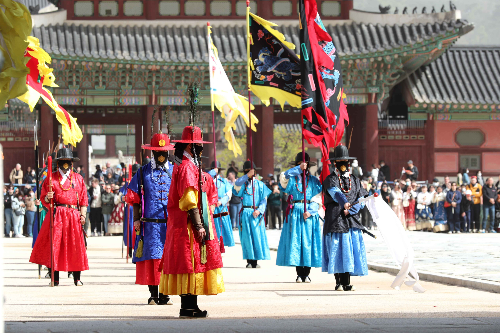
⚔️ Changing of the Guard Ceremony
This is one of Seoul's most spectacular free experiences — and most visitors don't know it exists until they stumble upon it.
The Royal Guard Changing Ceremony is a daily reenactment of the Joseon Dynasty guard change, performed by over 70 performers in historically accurate armor, wielding traditional weapons, accompanied by drums and ceremonial music. It runs for approximately 20 minutes and gives you the genuine feeling of stepping onto a Korean drama set — except it's been happening here for centuries.
| Ceremony Times | 10:00 AM and 2:00 PM (daily except Tuesday) |
|---|---|
| Location | Gwanghwamun Gate (main south gate) |
| Duration | ~20 minutes |
| Cost | Free — watchable without entering the palace |
| Closed | Every Tuesday / cancelled in heavy rain or snow |
Photography tip: Don't stand at the front center — everyone does and you'll have heads in every shot. Instead, position yourself slightly left of center, near the left wall as you face the gate. You'll get a cleaner angle with the procession coming toward you.
Arrive 20–30 minutes early during cherry blossom season — crowds are significantly larger in April.
👘 The Hanbok Hack: Free Entry
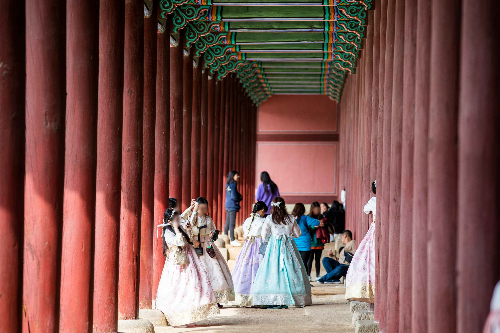
Wearing a hanbok (traditional Korean dress) gets you free admission to Gyeongbokgung — and all of Seoul's other royal palaces. This is real and widely used.
Dozens of hanbok rental shops cluster near Gyeongbokgung Station Exit 4 and the palace entrance. Most offer:
- Rentals from ₩15,000–35,000 for 2–4 hours
- Hair styling usually included
- Free admission to Gyeongbokgung, Changdeokgung, Changgyeonggung, and Deoksugung
Practical tip: Wear comfortable sneakers under the hanbok — the female hanbok skirt reaches the floor and nobody will see your shoes. The traditional Korean shoes (kkotshin) look beautiful but are extremely uncomfortable on Gyeongbokgung's stone and gravel paths. Your feet will hurt within 15 minutes.
🎭 Free English Guided Tour
This is the single best thing you can do at Gyeongbokgung — and most visitors skip it.
Free English-language guided tours depart daily from the Heungnyemun Gate information center, run approximately 90 minutes, and require no reservation. A knowledgeable docent walks you through the main structures explaining the history, architecture, and stories of the palace.
Without the tour, Gyeongbokgung is impressive buildings. With it, you understand why the pavilion is positioned exactly there, what happened in that hall, why the feng shui placement of the mountains matters. Same palace. Completely different experience.
📍 Meeting point: Heungnyemun Gate Information Center
🕐 Check current tour times at: royalpalace.go.kr →
🎫 Tickets & Practical Info
| Adult admission | ₩3,000 (~$2.20) | Free with hanbok |
|---|---|
| Combination ticket | ₩10,000 — covers all 4 palaces + Jongmyo Shrine (3-month validity) |
| Hours (March–May) | 9:00 AM – 6:00 PM |
| Closed | Every Tuesday |
| Subway | Line 3, Gyeongbokgung Station, Exit 5 (direct) |
🗺️ What's Nearby: Make a Full Day
- Bukchon Hanok Village — 15-minute walk east through traditional alleyways
- Gwanghwamun Square — directly south, with the statues of King Sejong and Admiral Yi. The Seoul Outdoor Library opens here April 23.
- National Folk Museum of Korea — inside the palace grounds, free with palace admission
- Cheong Wa Dae (Blue House) — the former presidential residence, just north of the palace. Opened to the public in 2022 after 74 years. Blue House Official Site →
- Insadong — 20-minute walk east for tea houses and traditional crafts
Gyeongbokgung isn't just a tourist attraction. It's the place where Korean identity was formed, challenged, nearly erased, and rebuilt.
Come in spring, when the cherry blossoms are falling on 600-year-old stone, and the drums of the guard ceremony echo across the courtyard. That sound has been here longer than almost anything else in Seoul.
It deserves to be heard. 🏯
2026.04.09 - [Seoul Travel Tips] - 7 Spring Street Foods You Must Try in Seoul Right Now
7 Spring Street Foods You Must Try in Seoul Right Now
Spring in Seoul has a smell.It hits you before you see anything — somewhere between the subway exit and the first food stall. Frying oil, sweet cinnamon, spicy gochujang, charcoal smoke. By the time your eyes catch up to your nose, you're already reachin
tk.giraffetrees.com
📷 Photo: Korea Tourism Organization (phoko.visitkorea.or.kr)